

Making Every Desert Downpour Count
Can Stormwater Help New Mexico Weather A Historic Drought?
Jun / 2026

It rushes down streets and arroyos, pools in great puddles in the middle of the road and evaporates when the sun reemerges at the end of a downpour. In arid states like New Mexico where every drop counts, seeing stormwater race away to the river or return to the atmosphere seems like an enormous missed opportunity.
It begs the question: how can we capture those downpours to ease our drought woes?
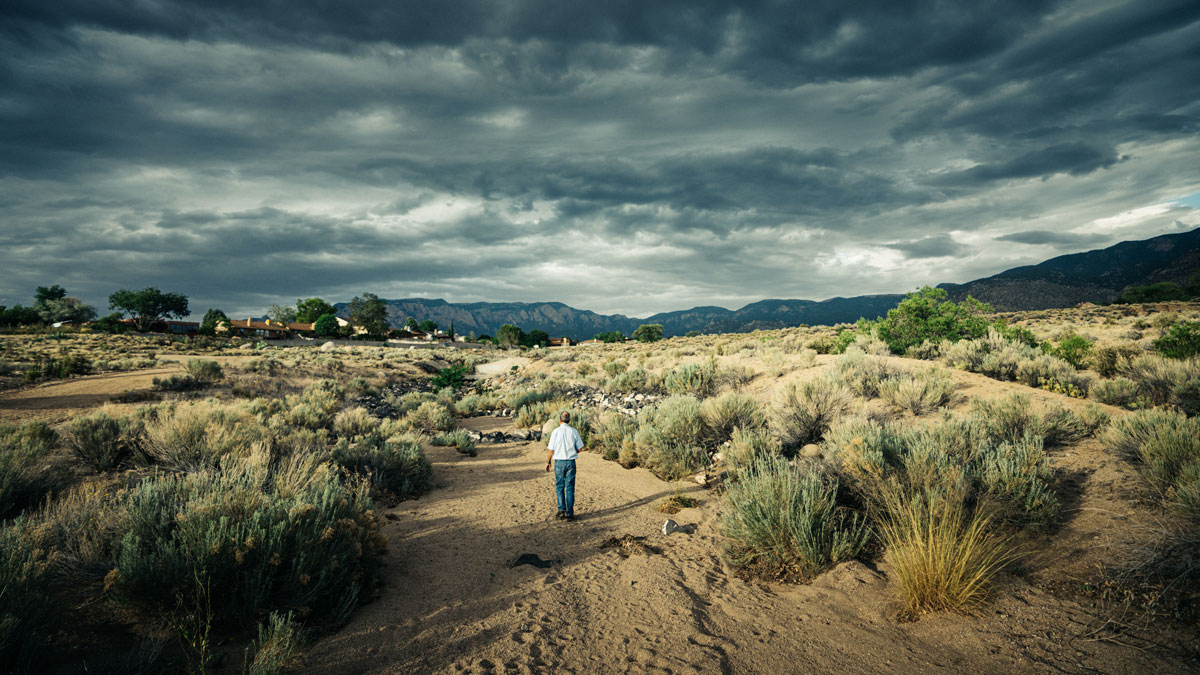
The Albuquerque west side has used a perhaps unexpected tool: the ground beneath it. When monsoon storms roll through each summer, a portion of the water from the west side’s sand-bottom arroyos infiltrates slowly into the earth, replenishing the aquifers that supply our communities’ water. No treatment plant, no pump station, just gravity and soil doing what nature designed them to do.

Bruce Thomson, an environmental engineer, former director of the UNM Water Resources Program, and current Albuquerque Metropolitan Arroyo Flood Control Authority (AMAFCA) board member, has watched the shift to working with the landscape play out across nearly five decades working on New Mexico water challenges.
“Up until about 1990, we tried to get stormwater off the site as rapidly as possible,” Thomson says. Concrete channels built in that era pushed water toward the river at 35 or 40 miles per hour. The approach is effective at flood control, but the water is gone in minutes and the force can take people with it. Over the last 10 years about 17 people have died in Albuquerque’s stormwater channels during flood conditions, says Thomson.
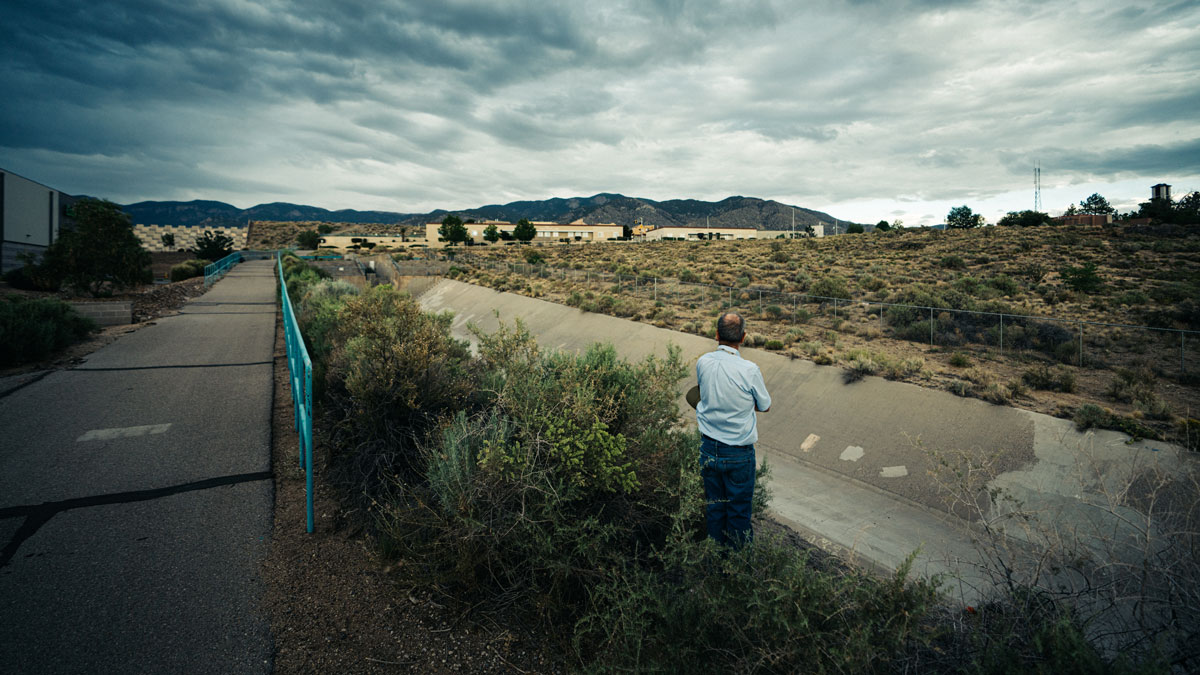
The shift to sand-bottom arroyos is not only safer for the public, it provides other benefits. “If we do our stormwater management right,” says Thomson, “our facilities can be very nice and feature recreation, open space, and environmental amenities.”
That shift in thinking has never mattered more. New Mexico is in the grip of what climatologists call the worst drought in 1,200 years, and both the State of New Mexico and the Albuquerque Bernalillo County Water Utility Authority have made stormwater recapture an aim of their water conservation plans. But turning rainfall into a reliable resource is not easy.

Part of the challenge is scale. New Mexico is one of the driest states in the US, averaging about 13.5 inches of rainfall annually. Applied to the Rio Grande as an example, only about 2% of the Rio Grande’s flow comes from direct rainfall. The vast majority of surface water in New Mexico arrives as snowmelt from the mountains in the northern part of the state and southern Colorado. That precipitation, though, is still part of a river system serving millions of people, and supplying water to farms and ecosystems. In a place where every drop is allocated and accounted for, capturing even a fraction of what currently evaporates off hot pavement is worth the effort.
The legal landscape adds another layer of complexity. New Mexico’s prior appropriation system treats surface water as a public resource, allocated to permit holders in order of seniority (this principle is sometimes summarized as “first in time, first in right”). State law requires a water right to hold captured rainwater no more than 96 hours. Without this limitation, an impoundment is diverting water that downstream rights holders are legally entitled to. Getting those water rights for stormwater capture is achievable, but it can’t happen informally. It requires planning, permitting, and often significant infrastructure investment.
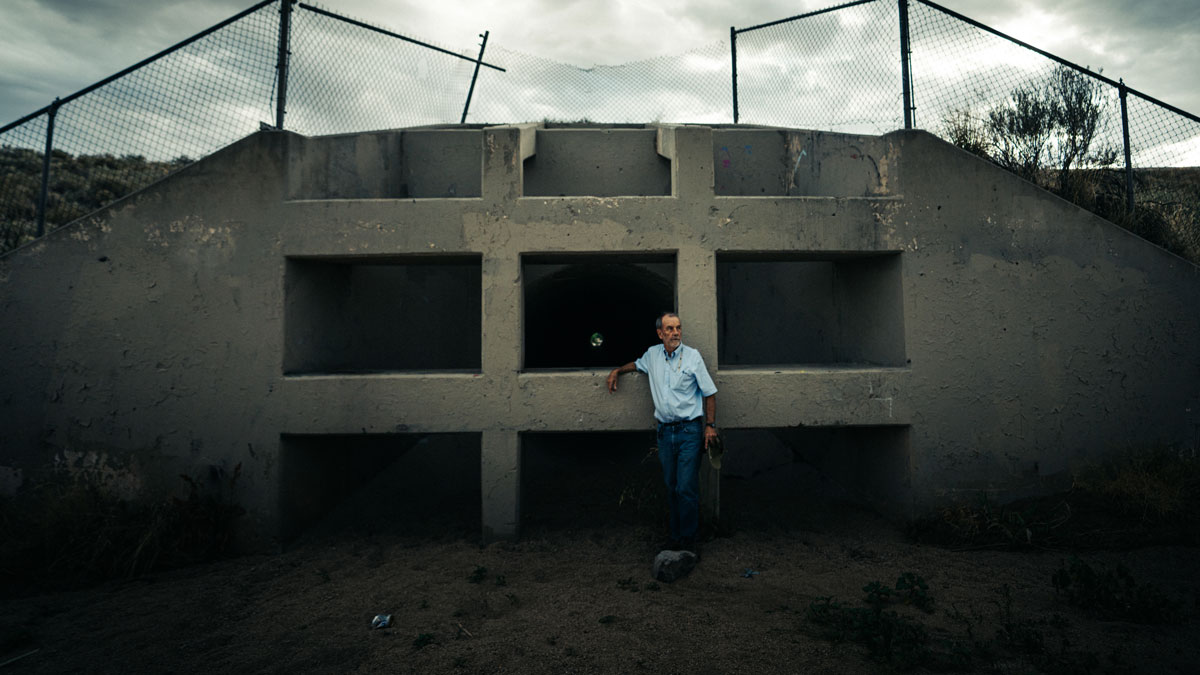
That infrastructure cost is the third obstacle. To actually pipe captured stormwater to homes and businesses, it needs to be collected, treated to remove the oil, debris, and contaminants it picks up on city streets, stored, and then distributed through a separate network of pipes. Building that system from scratch comes with a very big price tag.
So where does that leave a city or town trying to stretch its water supply through a prolonged drought?
The answer, Thomson suggests, may lie in working with watershed rather than against it. In Albuquerque, there’s a growing interest in capturing stormwater and recharging the aquifer through bioswales, infiltration galleries, and through our arroyos. These features allow stormwater to soak into the ground. There’s also permeable pavement, a strategy that allows water to seep through paved roads and parking lots rather than evaporate or race toward the nearest drain.
Beaver-dam analogs are also being deployed in small streams across the arid southwest. These simple, low-cost structures mimic the water-slowing effect of natural beaver dams to reduce erosion, retain moisture, and encourage natural aquifer recharge. None of these approaches involves treating water to drinking standards or constructing miles of new pipe. They focus on safely moving that stormwater while putting it to other beneficial use.
The more ambitious vision Thomson and other water managers are working toward proposes managing drinking water, stormwater, wastewater, and groundwater not as separate systems but as parts of a single interconnected cycle, a concept known as One Water. Albuquerque is already using aquifer storage and recovery to bank excess water underground during wet periods, then pump it back during dry ones, effectively turning the earth itself into a reservoir.
What these approaches share is a recognition that the goal of stormwater management has changed. It’s no longer just about moving water away from people safely, it’s about working with landscapes to make the most of what we have.